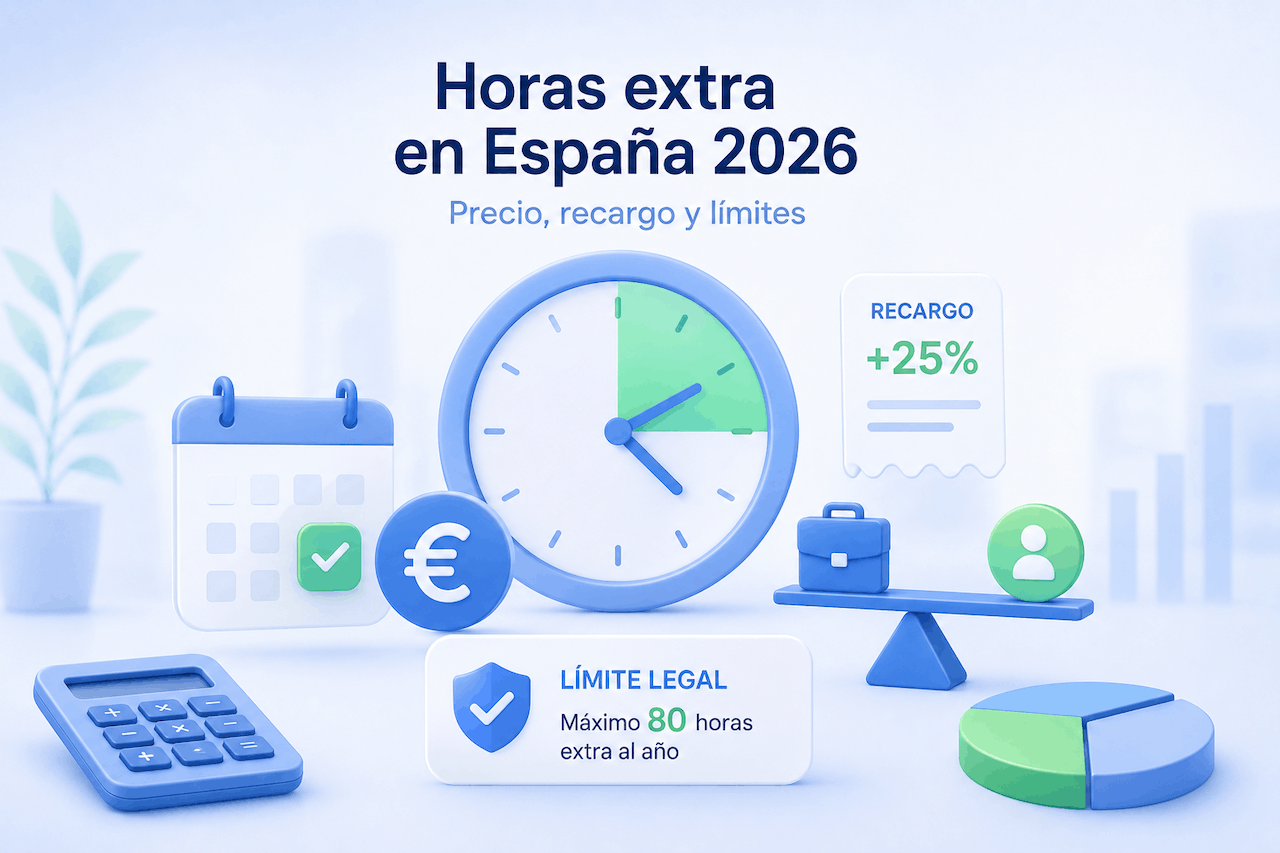
How to Calculate Overtime in Spain 2026: Pay, Rates & Limits
Learn how to calculate overtime in Spain step by step: hourly rate, collective agreement premium, the 80-hour annual limit and 2026 contributions.
Read moreStart your free trial of JornAda - 15 days free, no credit card required.
Try for free
Choosing time tracking software in 2026 is no longer just about complying with the law. It's about protecting your company from fines that can reach €6,250 per affected worker, optimising workforce management and preparing your business for the new mandatory digital clock-in regulation.
In this guide we analyse the 12 best time tracking programs available in Spain in 2026, with verified prices, real features, pros, cons and the type of company each one fits best.
If you got here looking for "best time tracking software", "clock-in app", "working day registration program" or "HR software comparison", this is the most comprehensive guide you will find.
Before comparing tools, it's worth understanding why this topic is critical in 2026.
Since Royal Decree-Law 8/2019, all companies in Spain have been required to record the daily working hours of their employees. But in 2026 the situation has tightened dramatically:
If you want to dig deeper into the regulation, check our complete guide on the new time tracking law in Spain.
Not all programs are equal. These are the seven objective criteria you should evaluate before deciding:
1. Real regulatory compliance
The software must be adapted to RDL 8/2019, generate reports required by the Labour Inspectorate, log modifications and retain data for 4 years. Beware of international platforms that do not specifically comply with Spanish legislation.
2. Available clock-in methods
A good solution must offer multiple clock-in methods: iOS and Android mobile app, web browser, tablet in kiosk mode with PIN, and optionally an RFID reader. Every company has different contexts: office, field work, multiple sites, remote work.
3. GDPR and data protection compliance
Employment data is sensitive data. Verify that servers are in the EU, that data is encrypted and, very importantly, that the system does not use biometrics (fingerprint or facial recognition). The Spanish Data Protection Agency has drastically restricted the use of biometrics for clock-in since 2023.
4. Real pricing, no fine print
The per-user price is just one part. Check whether there is a monthly minimum fee, implementation costs, mandatory extra modules or limits in lower plans. "Cheap" software can end up being the most expensive if it adds hidden charges.
5. Features included in the base plan
Some platforms split their product into modules: time tracking on one side, holidays on another, document management separate. Confirm what is included and what is not before signing.
6. Spanish-language support
An incident with your clock-in system can halt operations across the entire company. Spanish-language support, with fast response and knowledge of local regulations, makes the difference.
7. Ease of use for non-technical employees
A powerful software is useless if your employees don't understand how to clock in. The learning curve, access speed and consistency across devices are decisive factors for adoption.
Visual summary of the options we will analyse in detail:
What it offers
JornAda is Spanish software developed in Mallorca to comply 100% with Spanish labour regulations. More than 3,000 companies already use it in their daily operations. What sets it apart is that it covers both office and field work in the same system, with no extra modules.
Features included in any plan:
Price
Tiered pricing: from €2.00/user/month for 5 licences, down to €1.40/user/month from 50 licences. No commitment. No installation costs. 15-day free trial.
Support and origin
Spanish company with a local development team in Palma de Mallorca. Spanish-language support, deep knowledge of Spanish regulations.
Who it fits
JornAda scales from the self-employed worker with 1 employee to corporations with thousands of workers. Among our active clients there are companies with 4,100 employees, 1,900 employees and 700 employees, plus hundreds of SMEs and self-employed professionals. The platform is designed both for labour consultancies that manage multiple companies and for large corporations with complex multi-site operations, rotating shifts and thousands of employees on their payroll. It works especially well in hospitality, retail, construction, healthcare, industry and professional services.
Pros
JornAda combines features that are rarely found together on the same platform: the best value for money in the Spanish market, with all features included in any plan and no extra modules. Total regulatory compliance with RDL 8/2019 and the new 2026 regulation. Setup in less than 5 minutes with no need for technicians. No commitment or monthly minimums. Scales without friction from 5 to more than 4,000 employees on the same platform. Custom proposals are available for large companies with specific needs.
Cons
JornAda does not include an applicant tracking system (ATS) or its own payroll module, since it is designed to integrate with each company's labour consultancy. It has fewer third-party integrations than the larger HR suites, although it covers the most requested ones.
Check the pricing plans, explore the complete features or start your free trial.
What it offers
Factorial is one of the best-known HR suites in Spain, with headquarters in Barcelona and strong international expansion. It includes time tracking, holidays, absences, document management, recruitment and payroll on one platform. Its great advantage is the integration of multiple people management areas.
Price
From €5.50/employee/month. Pricing scales according to the modules contracted, and many key features (advanced reports, integrations, ATS) are in higher plans that can reach €9/user/month.
Support and origin
Spanish company headquartered in Barcelona, multilingual support.
Who it fits
Medium and large companies (30-200 employees) looking for an integral HR system and willing to invest in a complete suite. It is not the most suitable option for small SMEs with basic clock-in needs.
Pros
Cons
What it offers
Sesame HR is Spanish software very popular among SMEs, headquartered in Valencia. Modern design, strong focus on user experience and features for time tracking, holidays, absences, alert automation and report generation.
Price
From €4.50/employee/month, with plans tailored to specific needs. Monthly minimum of €82.50 in the most complete plans.
Support and origin
Spanish company headquartered in Valencia, Spanish-language support.
Who it fits
Small and medium-sized businesses looking for simplicity, fast deployment and polished design. Ideal for companies that highly value UX and prefer to pay more for a refined experience.
Pros
Cons
What it offers
Woffu is a Spanish startup originally from Barcelona, specialising in time tracking and absence management. It offers clock-in with geolocation, IP restrictions, reports and automatic categorisation of overtime.
Price
From €1.50/employee/month in its Lite plan, with higher plans adding extra features.
Support and origin
Spanish startup acquired by an international group, Spanish-language support.
Who it fits
Self-employed workers, startups and microenterprises that need a basic, affordable tool focused on clock-in and absences.
Pros
Cons
What it offers
Bizneo HR is a modular HR ERP with more than 16 modules available, including a powerful time tracking module with shifts, absences, overtime, automatic notifications and document management.
Price
From €6/employee/month, with a monthly minimum of €55. The total price can shoot up when adding several modules.
Support and origin
Spanish company with international clients, support in Spanish.
Who it fits
Medium and large companies (from 80 employees) that want to build their HR stack piece by piece and have their own HR department.
Pros
Cons
What it offers
Kenjo is an all-in-one HR software of German origin with an office in Madrid. It includes time tracking, absences, shifts, payroll and recruitment, with modern design and a strong focus on analytics and reporting.
Price
Starter Plan from €5.40/employee/month and Growth Plan from €9/employee/month.
Support and origin
German company with an office in Madrid, Spanish-language support.
Who it fits
Medium-sized companies that want a modern, international suite with European presence. Good option for companies with international growth plans.
Pros
Cons
What it offers
Bixpe is Spanish software headquartered in Madrid, designed especially for mobile teams and field workers. It allows clock-in with geolocation, report generation and mobile app access. It integrates clock-in and payroll management.
Price
Premium Plan from €2/employee/month. Basic features are free with no user limit.
Support and origin
Spanish company, Spanish-language support.
Who it fits
Sales teams, field technicians, companies with external services and businesses with high worker mobility.
Pros
Cons
What it offers
Clockify is international time tracking software with a robust free plan and paid options for advanced reports. It includes clock-in from mobile, web and desktop, time reports and billing per project.
Price
Standard Plan from $5.49/employee/month. Free version available for unlimited users.
Support and origin
International company, support mainly in English.
Who it fits
Freelancers and teams that want to measure project time and billing rather than comply with Spanish regulations. It is not the best option for companies that need to align with Spanish time tracking law.
Pros
Cons
What it offers
TimeCamp is an international time tracking tool with reports, invoicing and productivity plans. Focus on projects and per-hour profitability.
Price
From $2.99/employee/month.
Support and origin
International company, support in English.
Who it fits
Companies oriented towards international projects that need time and profitability analytics. Like Clockify, it is not the best option for legal compliance in Spain.
Pros
Cons
What it offers
Papershift is a German platform specialising in shift planning and personnel management. It enables schedules, time tracking, holidays and absences. Its focus is on companies with complex rotating workforces.
Price
From €6/employee/month.
Support and origin
German company with European presence, support in English and German.
Who it fits
Retail, hospitality and businesses with rotating workforces that value shift planning more than pure time tracking.
Pros
Cons
What it offers
Skello is a French platform specialising in shift management, with mobile app, reports and time tracking. Widely used in restaurant chains and retail with multiple locations.
Price
From €20/month, with additional costs depending on modules.
Support and origin
France, with international support.
Who it fits
Restaurant chains, retail with multiple locations and businesses with rotating shifts across multiple sites.
Pros
Cons
What it offers
Grupo SPEC is a long-established Spanish provider headquartered in Barcelona, combining access control software and hardware. It offers clock-in with biometrics, RFID and the mySpec app, alongside its netTime one platform.
Price
Custom, depending on licences and hardware contracted. Usually one of the most expensive options in the market.
Support and origin
Spanish company with decades of experience.
Who it fits
Large companies and industries with physical access control needs and complex processes.
Pros
Cons
After speaking with hundreds of companies that have migrated from one time tracking software to another, these are the recurring mistakes:
Choosing only by price
The cheapest software is not always the most cost-effective. If it doesn't comply with regulations or your team doesn't use it, you'll end up switching in six months at twice the cost.
Not verifying legal compliance
Many international platforms promise "time tracking" but do not generate valid reports for the Spanish Labour Inspectorate. Always confirm that the software is adapted to RDL 8/2019.
Confusing biometrics with security
Facial recognition and fingerprint scanning seem modern, but the Spanish Data Protection Agency has restricted their use for clock-in since 2023. Systems with mandatory biometrics can create legal problems.
Underestimating the learning curve
If your team doesn't understand how to clock in, your regulatory compliance is worthless. Test the software with real employees before deciding.
Forgetting about support
A system outage on a Monday at 8:00 a.m. can paralyse your entire company. Make sure you have Spanish-language support with a fast response time.
Any software you consider must include at least:
If you want to dig deeper into how a modern employee portal works, read our guide on employee portals in 2026.
For self-employed workers and microenterprises (1-5 employees)
Recommended: JornAda in its smallest plan, or Clockify in its free version if you only need internal tracking with no legal obligation.
For SMEs (5-50 employees)
Recommended: JornAda. It is the best value-for-money option in the market, with everything included and no extra modules. If you need a broader HR suite and have the budget, Sesame HR or Factorial are alternatives.
For medium-sized companies (50-200 employees)
Recommended: JornAda with a custom proposal. We have active clients in this range that value ease of use and competitive pricing over more expensive suites. Factorial or Bizneo HR are alternatives if you need ATS and integrated payroll on the same platform.
For large companies (200-1,000 employees)
Recommended: JornAda with a custom proposal. Among our active clients in this segment there are companies with more than 500 employees that have chosen JornAda for the combination of regulatory compliance, powerful multi-site support and tiered pricing. Kenjo or Bizneo HR are alternatives if you prioritise a broad HR suite.
For corporations (1,000+ employees)
Recommended: JornAda with a custom proposal. We have closed contracts with companies of more than 5,000 employees that value full traceability, unified multi-site management, the employee portal with bulk payslip delivery via OCR and AI, and direct support in Spanish. For industries with complex physical access control, Grupo SPEC remains the reference provider in Spain.
For hospitality and restaurants
Recommended: JornAda (especially with PIN tablet and WiFi RFID for kitchens), Skello or Papershift for chains with many locations.
For retail and commerce
Recommended: JornAda (powerful multi-site) or Skello (retail shift specialist).
For construction and site work
Recommended: JornAda with mobile app + geolocation for mobile workers, or Bixpe specialising in field teams.
For companies with remote work
Recommended: JornAda or Sesame HR. Both with mobile app and web for clocking in from home.
For labour consultancies
Recommended: JornAda. It allows you to manage multiple companies from a single panel and has document management with OCR for bulk payslip delivery.
Is time tracking mandatory in Spain in 2026?
Yes. Since Royal Decree-Law 8/2019, all Spanish companies (including self-employed workers with employees) are required to record the daily working hours of their staff. In 2026 this obligation has been reinforced with digital recording and remote accessibility for the Labour Inspectorate.
What fines are there for not complying with time tracking?
Fines for serious infractions of the working hours register range from €625 to €6,250 per affected worker. A company with 30 employees may face fines exceeding €30,000 in a single proceeding.
Is fingerprint or facial recognition clock-in legal?
The Spanish Data Protection Agency has drastically restricted the use of biometrics for clock-in since 2023. It is only allowed when strictly necessary and proportionate, which in most companies is not the case. Systems without biometrics like JornAda are the safest option.
Can I keep using Excel to clock in?
No. The new 2026 regulation requires digital, immutable and traceable recording. Excel spreadsheets can be modified without leaving a trace, which makes them invalid before the Inspectorate.
How much does time tracking software cost in Spain?
Prices range from €1.40/user/month (JornAda) to €9/user/month (Kenjo Growth). The market average is around €4-5/user/month for complete suites.
How long must I keep working hours records?
4 years, according to RDL 8/2019. The data must be accessible to employees, their legal representatives and the Labour Inspectorate.
Can employees see their own records?
Yes, it's mandatory. Any software must allow workers to consult their working day, hours worked and overtime at any time. An employee portal is the most effective way to comply.
What's the difference between time tracking and an employee portal?
Time tracking only records clock-ins and clock-outs. The employee portal is a more complete platform that includes time tracking, payslips, documents, holidays and internal communication. The best solutions (such as JornAda) integrate both into a single platform.
Can I switch time tracking software midway through the year?
Yes. Most platforms do not require a commitment. JornAda, for example, lets you cancel at any time. The important thing is to export the data from your previous software to maintain traceability.
Do I need special hardware to clock in?
It's not mandatory. Most modern software (JornAda, Sesame, Factorial) allows clock-in from mobile, computer or tablet without the need for physical clocks. If your company has a high volume of employees passing through a single point, a tablet in kiosk mode or an RFID reader can be useful.
How does WiFi RFID clock-in work?
WiFi RFID allows each employee to clock in by tapping a card or keyfob on the reader, with no cables or USB connection required. It is ideal for kitchens, warehouses or environments where a phone is not practical. JornAda includes this feature with no extra cost per device.
What happens if an employee forgets to clock in?
Good software sends push notifications when it detects an employee hasn't clocked in at their usual time. In addition, the manager can add the clock-in manually, leaving a log with timestamp and author to maintain traceability.
If you have more questions, check our complete FAQ section or contact our team.
In 2026 the key is no longer just to clock in. It's about complying with the new regulation, avoiding fines that can reach thousands of euros and improving people management in your company, regardless of its size.
After analysing the 12 best time tracking software solutions available in Spain, this is our final assessment.
If you're looking for the best value for money, full legal compliance and all features included with no extra modules, JornAda is our main recommendation. From €1.40/user/month for SMEs and with custom proposals for large companies, it offers multi-device clock-in, AI document management, digital signature, multi-site and a complete employee portal. It works equally well for self-employed workers, SMEs and corporations with several thousand employees.
If you need an integral HR suite with ATS, payroll and many additional modules, and your budget allows it, Factorial, Kenjo or Bizneo HR are solid alternatives. For international teams or project tracking, Clockify or TimeCamp are useful options, although they are not adapted to Spanish regulations. For hospitality and retail with multiple locations, Skello or Papershift offer specific shift planning features. For large industries with physical access control, Grupo SPEC is the reference provider in Spain.
The best recommendation we can give you is to test the software with your real team for at least one week. Software your team understands is software that gets used. And software that gets used is the only software that works.
Get started with JornAda today
No installation. No commitment contracts. No IT technicians. Setup in less than 5 minutes for companies of any size.
Last updated: April 2026. Article reviewed monthly with the latest regulatory changes and the most recent information on each software analysed.
Start complying with time tracking regulations today. 15-day free trial, no credit card needed.
Contact
Fill in the form and we will get back to you within 24 hours.
Contact Name
Company Name *
Email *
Type your message here...
By sending you accept the Terms and Conditions and the Privacity Policy
Learn how to calculate overtime in Spain step by step: hourly rate, collective agreement premium, the 80-hour annual limit and 2026 contributions.
Read more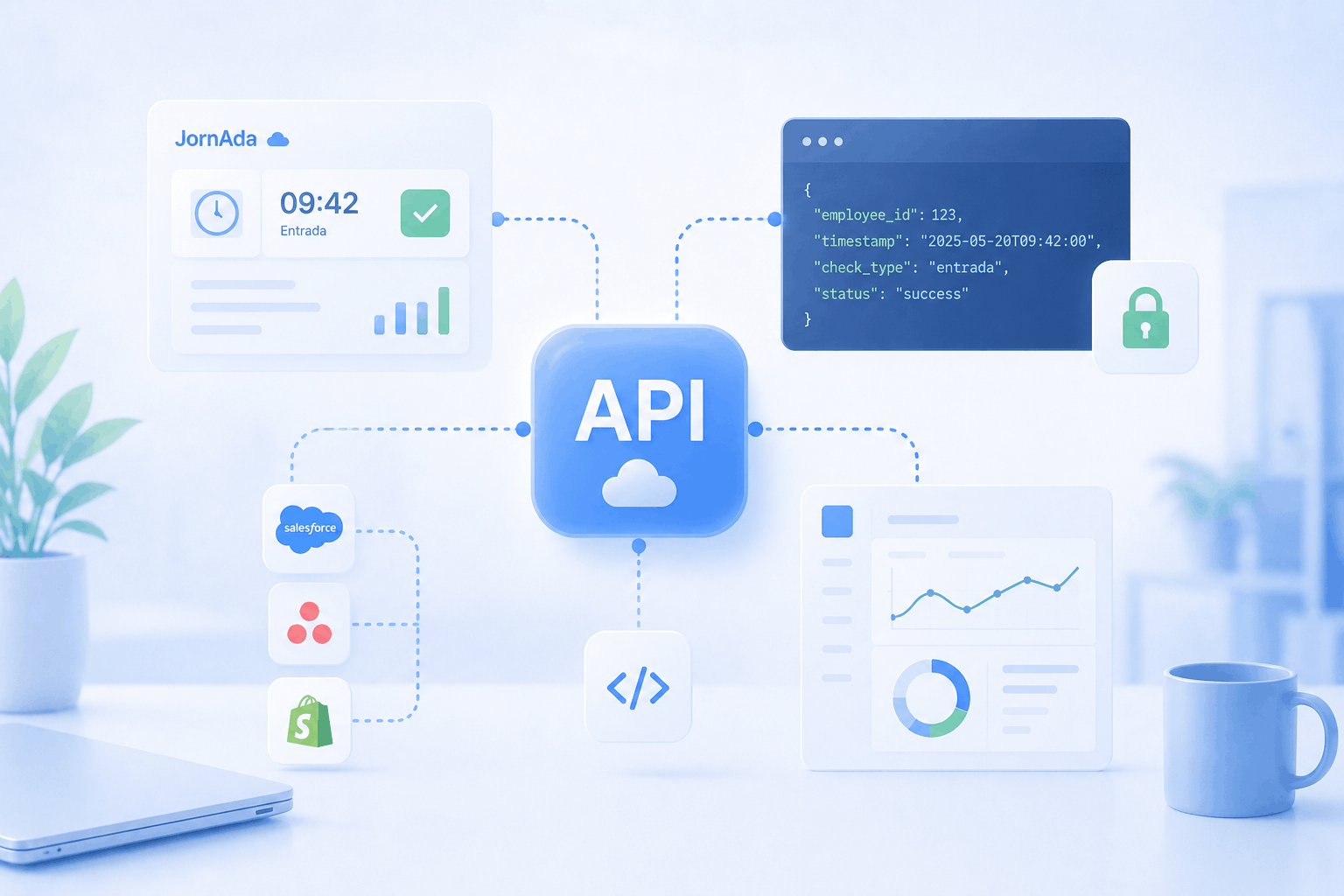
Meet JornAda's REST API: read employees, clock-ins, absences and time balances, and clock in from your own systems to connect time tracking with your BI, HRIS and payroll.
Read more
Spain's Council of State has issued a ruling against the digital time tracking decree pushed by Minister Yolanda Díaz. But the Ministry of Labour isn't backing down. Here's what happened, what's changing, and why you should prepare now.
Read more