Your team doesn’t hate clocking in. It hates YOUR time tracking system.
Deep down, your team doesn’t hate time tracking. What they hate is being forced to use a clunky, confusing, slow piece of software just to comply with the time tracking law in Spain (control horario).
If every day starts with “wait, how do I clock in again?” or “the app crashed, I’ll do it later”, your problem is not your people. Your problem is your time tracking system.
In this article we’ll talk about:
– Why most systems fail in real life, even if they are “feature rich”.
– What Spanish law really cares about (hint: it’s simpler than you think).
– How to choose an employee time tracking app that your team actually uses.
– Why many companies in Spain are moving from big HR suites like Factorial or Sesame HR to leaner tools like JornAda.
The ugly truth: your people hate friction, not time tracking
Imagine this morning in your company.
Your team opens the time tracking app. It takes forever to load. The login expires every week. The “Clock in” button is hidden under three menus. To request a change, they must fill a form that feels like doing their taxes.
By the third day, nobody believes in the system anymore. They forget. They guess. They tap at random. They start to hate the word “fichar”.
The problem isn’t the law. The problem is UX.
A good control horario tool should feel like WhatsApp or Stripe: fast, obvious, minimal, designed to disappear into the background. Your team wants:
– One tap to clock in.
– One tap to clock out.
– Clear visibility of today’s hours, shifts and absences.
– Zero training.
If your current tool can’t deliver that, it’s only a matter of time before everyone quietly gives up on it.
The law is boringly clear (and that’s good for you)
The time tracking rules in Spain are written down in black and white in the Real Decreto-ley 8/2019. It basically says:
– You must record the start and end of each working day.
– You must keep those records for four years.
– You must be able to show them to employees and labour inspectors.
That’s it. The law doesn’t say you need an over-engineered HR monster. It doesn’t demand twenty modules, performance reviews, OKRs and a social intranet. It just wants a reliable, tamper-proof time and attendance system.
So if your current solution feels like flying a plane just to switch on a light, you’re overpaying in money, time and patience.
Big HR suites vs focused time tracking: who are you really buying for?
Platforms like Factorial or Sesame HR are great if you want a full corporate HR stack: recruitment, performance, surveys, training, expenses… and somewhere inside all that, a time tracking module.
But let’s be honest: most small and mid-sized companies in Spain just want to:
– Comply with the law.
– Track real working hours and overtime.
– Manage shifts and absences.
– Give employees a clean employee portal for payslips and documents.
– Do all of this without explaining the system every Monday.
If you buy the same tool a 2,000-employee multinational uses, you might end up with:
– Features nobody uses.
– Screens nobody understands.
– A bill that hurts for what you actually need.
That’s why many companies are now searching “alternative to Factorial”, “alternative to Sesame” or “simple time tracking app Spain” and landing on products that are built around one idea: time tracking first, everything else second.
What a “don’t-hate-it” time tracking system looks like
Let’s translate all of this into something practical. A time tracking system your team won’t hate should:
1. Be brutally simple for employees.
Clock in, clock out, see today, see this week. No rocket science. If someone joins your company, they should be able to use the app in one minute. If the UI needs a manual, it’s already wrong.
2. Support real life, not just office life.
People work from the office, from home, from the road. A modern system must allow:
– Mobile app clock-in for remote work and field roles.
– Web clock-in for office roles.
– RFID/PIN terminals for factories, workshops and shops.
You shouldn’t have to hack the system every time someone works outside the building.
3. Handle shifts, absences and documents in one place.
Your HR team doesn’t want to juggle four tools. The perfect setup is one app where you can:
– Plan and edit shifts without crying.
– Approve vacations and leaves.
– Upload payslips, contracts and company documents to a secure employee portal.
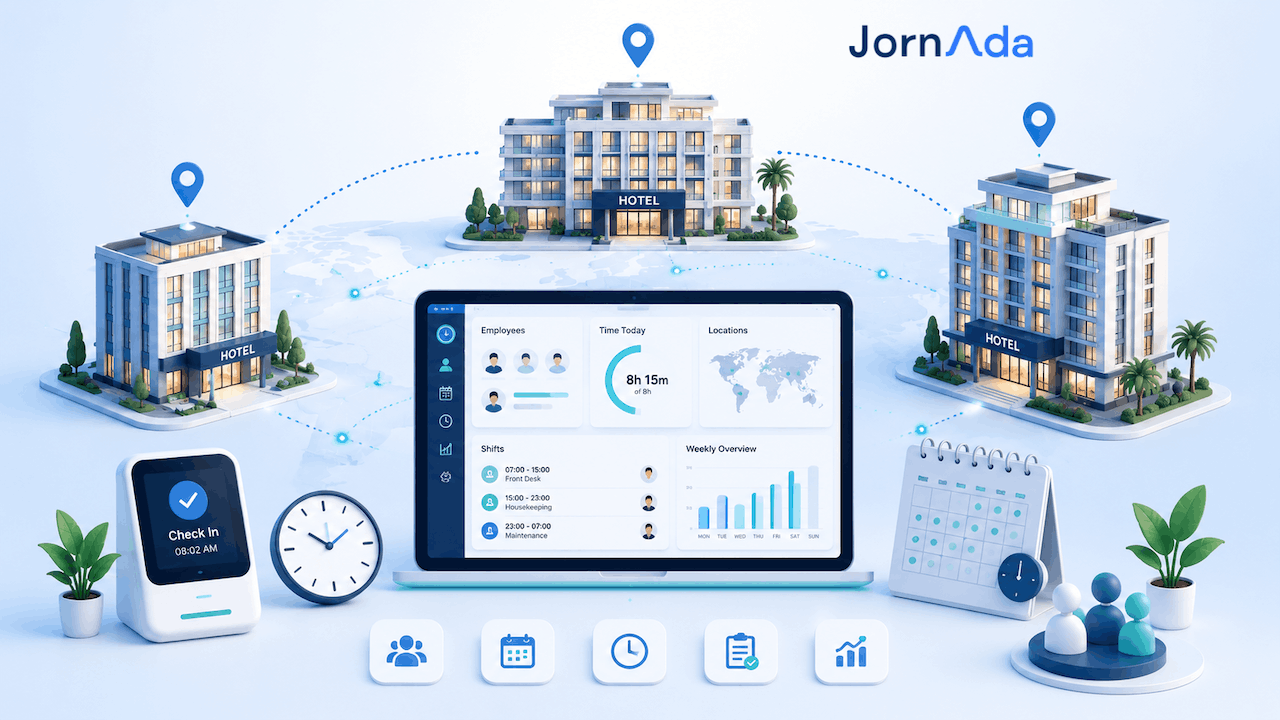
This is where a product like JornAda shines: it was designed from day one around control horario, shift management, absences and a simple portal for employees, not as an afterthought.
4. Be clearly legal and inspection-ready.
You need to sleep well at night. That means:
– Every clock-in and clock-out is stored safely for years.
– If you change a record, the system logs who changed what and when.
– You can export a clear report for any employee and any period in seconds.
Whether you use JornAda or another system, this is non-negotiable if you want to comply with Spanish time tracking law.
5. Be priced for reality, not for vanity.
You shouldn’t pay enterprise-suite pricing if you only need time tracking, shifts and a portal. JornAda’s pricing is based on licence packs, which usually works out cheaper per employee for Spanish SMEs than per-seat enterprise bundles that include features you’ll never open.
Why JornAda is built for teams that are done with overkill
JornAda was not born as a generic global HR suite. It was built in Spain, for Spanish companies, around one core idea: make time tracking, shifts and the employee portal ridiculously easy — and make it legal by design.
With JornAda your team can:
– Clock in via app, web, RFID or PIN in one tap.
– See who is online, who is on leave and who is working from home.
– Manage shifts in a clean, modern interface inspired by products like WhatsApp, Airbnb and Stripe — not by 1998 ERP screens.
– Download their own payslips and documents without emailing HR every month.
And your company can:
– Comply with the time tracking law in Spain without spreadsheets or paper horror stories.
– Pass inspections with clear, exportable data.
– Stop wasting money on modules you don’t need.
You can explore more about how JornAda handles control horario, shifts and the employee portal in their articles section, or just ask for a demo or trial from the homepage.
The mindset shift: from “they hate clocking in” to “they don’t even think about it”
Here’s the goal: you don’t want your team to love time tracking. You want them to forget about it.
You want clocking in to be so fast and so obvious that it’s like opening their laptop or turning on the coffee machine. A small gesture that doesn’t drain mental energy, doesn’t trigger eye-rolls and doesn’t start the day with friction.
If right now your employees hate your time tracking system, it’s not because they hate being fair about hours. It’s because you gave them the wrong tool.
The good news? You can fix that.
Choose a system designed for humans, not for feature lists. Make sure it’s 100% legal in Spain. Keep it simple, transparent and fair. Whether you pick a focused tool like JornAda or another solution, put your team’s experience at the centre.
Your people don’t hate clocking in. They hate bad systems.
Give them a better one.