Introducing Emotional Clock-In! The employee wellbeing software big companies have been waiting for
Today is a big day for JornAda and, more importantly, for your team.
We're launching Emotional Clock-In: the simplest, most anonymous and most consistent way to measure employee wellbeing across your organisation. Five emojis. Two seconds. And for the first time, a real, reliable and zero-marginal-cost metric of how your team is actually feeling.
If you lead Human Resources, this is the indicator you've been asking for. If you're a CEO or CFO, this is the KPI that was missing from your executive dashboard. If you manage hundreds or thousands of people, this is the tool that changes the game.
Let's get to the point: in this article we explain what emotional clock-in is, how it works, why it's a game changer for big companies, how much it costs (very little), how it compares to the global wellbeing leaders, and how to roll it out in less than a week. If you got here looking for "employee wellbeing software", "mood tracking workplace", "measure team morale", "early burnout detection" or "employee satisfaction software for large companies", this is the most complete guide you'll read this year.
Table of contents
What is emotional clock-in?
It's the most natural gesture in the world, brought to the moment where it has the most impact.
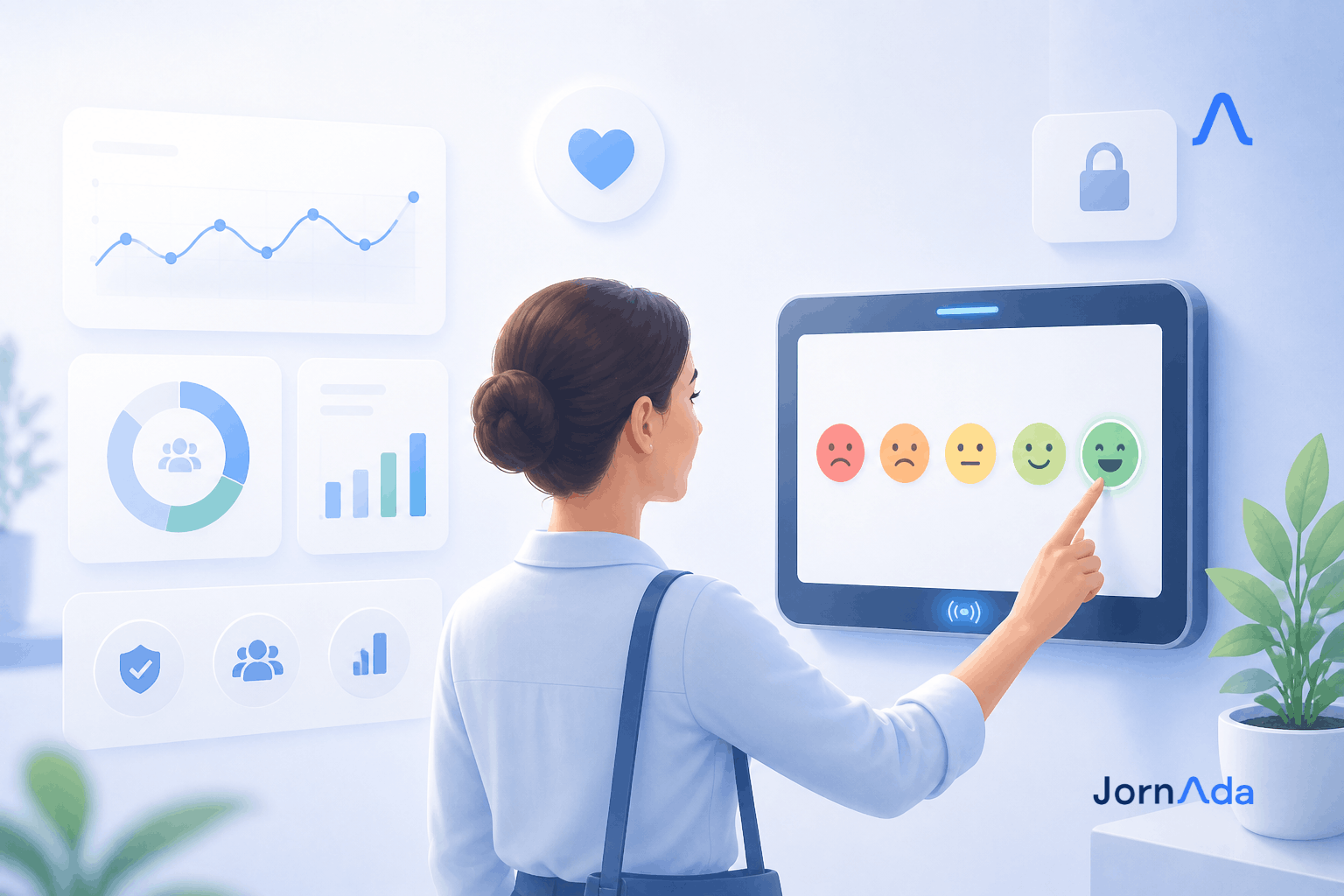
When an employee clocks out in JornAda, a simple question pops up: "How did you feel today?". Five emojis to choose from:
- 😔 Very bad
- 😟 Bad
- 😐 Okay
- 😊 Good
- 😄 Great
The employee picks one. If they want, they add an optional comment. They decide whether to send it with their name or anonymously. Done. Two seconds. End of day.
Those two seconds, multiplied by your entire workforce, multiplied by five days a week, give you something no annual survey can: the real emotional pulse of your organisation, in real time, every single day.
Why it matters (the numbers that scare CFOs)
Employee wellbeing isn't a "soft" topic. It's one of the KPIs with the highest financial impact in any large company.
Numbers you probably already know, but worth keeping in front of you:
- 76% of employees have experienced burnout in the past year
- Voluntary turnover in large companies hovers around 18% annually
- The average cost of replacing a qualified employee exceeds €30,000
- Stress and anxiety leave is now the number one cause of absenteeism in large European companies
- A 4,000-employee company with 18% turnover loses 720 people a year
Quick math: 720 people × €30,000 = €21.6 million a year evaporating into avoidable turnover. You only need to reduce that turnover by 3 points to save more than €3 million annually.
Emotional clock-in isn't an HR vanity project. It's a financial lever for the CEO.
Why traditional wellbeing apps don't work
Before launching Emotional Clock-In we analysed the global market: Welbot, Unmind, Personify Health (formerly Virgin Pulse), Headspace for Work, Modern Health, Wellable, Reward Gateway. Powerful platforms, no doubt. But they all share the same structural problem when applied to large companies.
Problem 1: nobody opens them
They're separate apps. Real adoption rate: 12-22% in the best case. If only two out of ten people use the tool, the data is noise.
Problem 2: those who do open them, do it because of gamification
When you add points, rewards and rankings to force usage, the data gets contaminated. People answer what the company wants to hear, not what they actually feel.
Some platforms add ranking, prizes and competitions to drive engagement, but this contaminates the metric: employees answer to win, not to be honest.
Problem 3: they cost a fortune
Between €6 and €12/employee/month. For a 4,000-person company that's €24,000-48,000 per month. Before the program proves any ROI, the budget gets cut.
Problem 4: data arrives too late
Annual or quarterly surveys. By the time the problem appears in the report, three resignation letters are already on your desk.
Wellbeing software isn't bad. It's the wrong format for the wrong audience. Big companies don't need yet another app that few will open. They need a daily, reliable and inexpensive metric.
The idea: wellbeing inside the clock-in, not in another app
The question we asked ourselves was: is there a moment of the day when EVERY employee, without exception, clicks somewhere? Yes: when they clock out.
That gesture is already part of the worker's routine. They do it because the law requires it. They do it because the system reminds them. They do it because it closes their day.
What if right at that moment, we add two seconds to ask how they felt? Just two. Without opening another app. Without new credentials. Without invasive notifications.
The result:
- Adoption above 80% from the first week
- Daily data, not quarterly
- Zero marginal cost on top of your current clock-in plan
- No friction because it happens at a natural moment
That's the new category. We call it emotional clock-in. And JornAda is the first platform in the world to integrate it natively.
How it works in 3 steps
Step 1: the employee clocks out
It doesn't matter how. Mobile app for iOS and Android, web browser, tablet in kiosk mode with PIN, WiFi RFID reader. Any of JornAda's standard clock-in methods triggers emotional clock-in at the end of the working day.
Step 2: pick an emoji
"How did you feel today?" 😔 😟 😐 😊 😄. Pick one. Two seconds. If they want, add a free-form comment with extra context.
Step 3: choose anonymity
Before sending, the employee decides: with my name or anonymous? The choice is theirs, every single time. And when they choose anonymous, the system aggregates the vote into the team without any technical possibility of identifying who said what.
Done. End of day.
Real anonymity, not marketing anonymity
This is where 90% of traditional wellbeing platforms cheat. They say "it's anonymous", but technically the system knows who voted what. If management decided to look up, they could.
JornAda works differently, and this detail is the difference between your team being honest or not:
- The employee decides on each response whether to send it with their name or anonymously
- When they choose anonymous, administrators see the team aggregate, with no technical possibility of cross-referencing the vote with a specific worker
- If a team is very small (fewer than 5 people), responses are aggregated into a larger group to prevent identification by elimination
- GDPR compliance from minute one
- Servers in the European Union with encryption in transit and at rest
- No biometrics of any kind
A tool that measures mood is only useful if people feel safe answering honestly. That's why anonymity at JornAda isn't a marketing promise. It's a technical guarantee built into the architecture.
The dashboard your CEO will want to see every Monday
The Head of People (or each team's direct manager, depending on assigned permissions) accesses a visual panel with everything they need:
7-day satisfaction average
A clear figure, from 1 to 5, reflecting the team's emotional state over the past week. It's the "thermometer" your Executive Committee reviews first thing on Monday.
Trend graphs
Daily, weekly and monthly evolution. This is where the real value appears: a sustained drop over 10 days in a specific team is a clear and actionable warning signal.
View by department, location or shift
In large companies, the global aggregate is misleading. The average can look fine while a specific team is collapsing. JornAda lets you filter by department, workplace, shift, manager or any organisational dimension.
Qualitative comments
Optional comments (always respecting anonymity if the employee chose it) provide context that numbers can't. This is where the real clues about what's going on appear.
Configurable alerts
Set thresholds and receive automatic notifications when a team drops below a defined level or when the trend turns negative for several days.
Why HR Managers are emailing us
If you lead Human Resources at a large company, this section is for you.
You go from reactive to proactive
Until today, HR puts out fires. Resignation arrives, stress leave hits, complaint escalates. With emotional clock-in you see the symptoms weeks earlier and can act in time.
You speak with data in the Executive Committee
When the CEO asks "how is the team?", the answer stops being an opinion. It becomes a verifiable figure with trend, segmentation and evolution. Your authority in the committee multiplies.
You detect middle management problems
One location with a 4.2 average and another with 2.8 tells you more about your middle managers' style than any 360-degree review. And it tells you without expensive processes.
You justify wellbeing investments
When you defend a mental health program, leadership training or a team intervention, you now have the data that justifies the investment and, afterwards, measures real impact.
You document for certifications
Great Place to Work, B Corp, ISO 45003 (psychosocial health management). Emotional clock-in provides the continuous metric these certifications require.
You improve your employer branding
Companies that measure and communicate their commitment to wellbeing have better reputations on Glassdoor, LinkedIn and job sites. Direct result: higher quality candidates and lower talent acquisition costs.
Why CEOs and CFOs approve it in 5 minutes
If you lead a company or control its budget, this section is for you.
It's a new KPI in your executive dashboard
Alongside revenue, margin, productivity and turnover, you now have average team satisfaction. Monthly, comparable to the previous month and to the same month last year. Talent management enters your executive dashboard just like the P&L.
The ROI is brutal and verifiable
3 percentage points less turnover in a 4,000-person company equals more than €3 million saved per year. The module costs a tiny fraction of that, because it's integrated into the time tracking software you already need by law.
You reduce legal and reputational risk
Workplace conflicts, stress leave and psychosocial risk claims are increasingly frequent and costly. Having a continuous wellbeing metric is the best evidence of due diligence in front of an inspection or a lawsuit.
You comply earlier than your competition
European regulation on psychosocial risks (ISO 45003 and related directives) is moving fast. Companies already measuring will have a regulatory advantage of several years when this regulation becomes generally enforceable.
It's a low-risk decision
No multi-million enterprise contracts, no commitment, no implementation cost. If it doesn't work, cancellation is immediate. But, looking at the adoption data, it will work.
ROI: the cost of NOT measuring wellbeing
The math is direct. Take a company with 4,000 employees and an average replacement cost of €30,000:
- Current turnover at 18%: 720 people/year × €30,000 = €21.6 million/year in turnover costs
- Reduction of 3 points (to 15%): 120 fewer people × €30,000 = €3.6 million saved per year
- Reduction of 5 points (to 13%): 200 fewer people × €30,000 = €6 million saved per year
And that's just turnover. Adding savings from reduced stress leave, productivity gains and fewer legal disputes, the calculation easily multiplies by 1.5 or 2.
JornAda's emotional clock-in module pays for itself with a single avoided retention case per year. And in a 4,000-person company, there are dozens of retention opportunities every year.
JornAda vs. Welbot, Unmind, Personify Health, Headspace and Modern Health
JornAda vs. Welbot
Welbot is a British wellbeing platform with scientific backing and real-time reporting. It's serious and built for enterprise. But it lives in a desktop app separate from the employee's flow, which limits adoption to standard sector levels. JornAda integrates wellbeing into the clock-in, doesn't add another app.
JornAda vs. Unmind
Unmind is a reference in workplace mental health, with a focus on self-care, therapy and mood tracker. It's an excellent tool, but its average adoption rate in large European corporations is 18-22%. JornAda starts from the clock-in, already integrated into the routine, and exceeds 80% adoption from the first week.
JornAda vs. Personify Health (formerly Virgin Pulse)
Personify Health is a very complete enterprise suite, with benefits administration and gamification. A serious option for North American multinationals with large budgets and plans that can reach several million per year. JornAda doesn't compete in integral enterprise suites; it offers the daily wellbeing metric at a fraction of the cost, integrated with your legal time tracking.
JornAda vs. Headspace for Work
Headspace is mindfulness, meditation and stress management (between €2 and €6/employee/month). It doesn't measure wellbeing, it offers content to improve it. It's complementary, not substitutive. Many companies combine both: Headspace for content, JornAda for the metric.
JornAda vs. Modern Health
Modern Health gives access to certified therapists and coaches (€6-12/employee/month). Excellent for large companies that want to offer individual therapy to employees. JornAda isn't a clinical platform, but it is the measurement foundation that lets you know when and where this service is needed.
Positioning summary
JornAda doesn't compete with wellbeing platforms. It creates a new layer: the daily metric of emotional wellbeing, integrated with the legal compliance of time tracking. Once you have that metric, you decide whether to complement it with content (Headspace), therapy (Modern Health) or integral programs (Personify, Welbot, Unmind).
The logical order is: first measure. Then act. JornAda does the first one better than anyone.
It's already running in companies with thousands of employees
Among JornAda's active clients there are large corporations that chose the platform for the combination of regulatory compliance, scalability and, now also, the wellbeing features.
Corporation with more than 4,100 employees
Multi-site company in Spain with high volume of rotating shifts. Before emotional clock-in it relied on annual surveys to measure morale. Now it gets a daily metric with site and department segmentation, which has already allowed the team to detect localised pockets of dissatisfaction that have been addressed before turning into turnover.
Client with around 1,900 employees
Service sector, workforce spread across dozens of locations. The ability to compare emotional state between sites has been particularly useful for identifying middle management issues that traditional surveys couldn't catch.
Industrial group with more than 700 employees
Split shifts and complex rotations. Emotional clock-in has allowed the company to quantify the impact of changing a shift supervisor and serve as objective evidence in an internal promotion decision.
All these clients agree on one thing: the module doesn't require a new tool, doesn't add significant per-employee cost, and integrates with a flow they already had. Three "yes" answers in a row. That's why approval is fast.
From zero to first insight in 7 days
Activating emotional clock-in in a large company takes much less than any technology lead expects.
Day 1: technical activation
The module is enabled from JornAda's admin panel. No installation. No development. No additional integration with existing systems.
Day 2-3: internal communication
Human Resources communicates to the team what emotional clock-in is, how it works and how anonymity is guaranteed. We provide ready-to-use communication templates and an explainer video. This phase is critical: the honesty of responses depends on trust.
Day 4-7: first responses
Employees start clocking out with emotional ratings. The typical adoption curve exceeds 60% in the first week and surpasses 80% by week three.
Week 2-4: first patterns
The dashboard starts showing meaningful trends. Differences between departments, daily evolution, qualitative comments. This is where HR begins making data-driven decisions.
Month 2-3: first interventions
The first actionable case appears: a team with sustained downward trend or a site with worse ratings than the average. Time to act.
JornAda offers direct support throughout the entire process, with specific guidance for large rollouts (phased onboarding, manager training, permission configuration by hierarchy levels).
Privacy and GDPR compliance
This is where your Legal Department approves rollout without blinking.
Servers in the European Union. Data encrypted in transit and at rest. Zero international transfers outside the European Economic Area.
GDPR compliance. The legal basis for processing is the employee's express voluntariness on each response.
No biometrics. JornAda doesn't use facial recognition, fingerprint or any biometric data. This is a critical advantage over other platforms, given that the Spanish Data Protection Agency has drastically restricted workplace biometrics since 2023.
Real voluntariness. Emotional clock-in is completely optional. An employee can clock out without rating their mood. And they can switch between anonymous and named responses at any time.
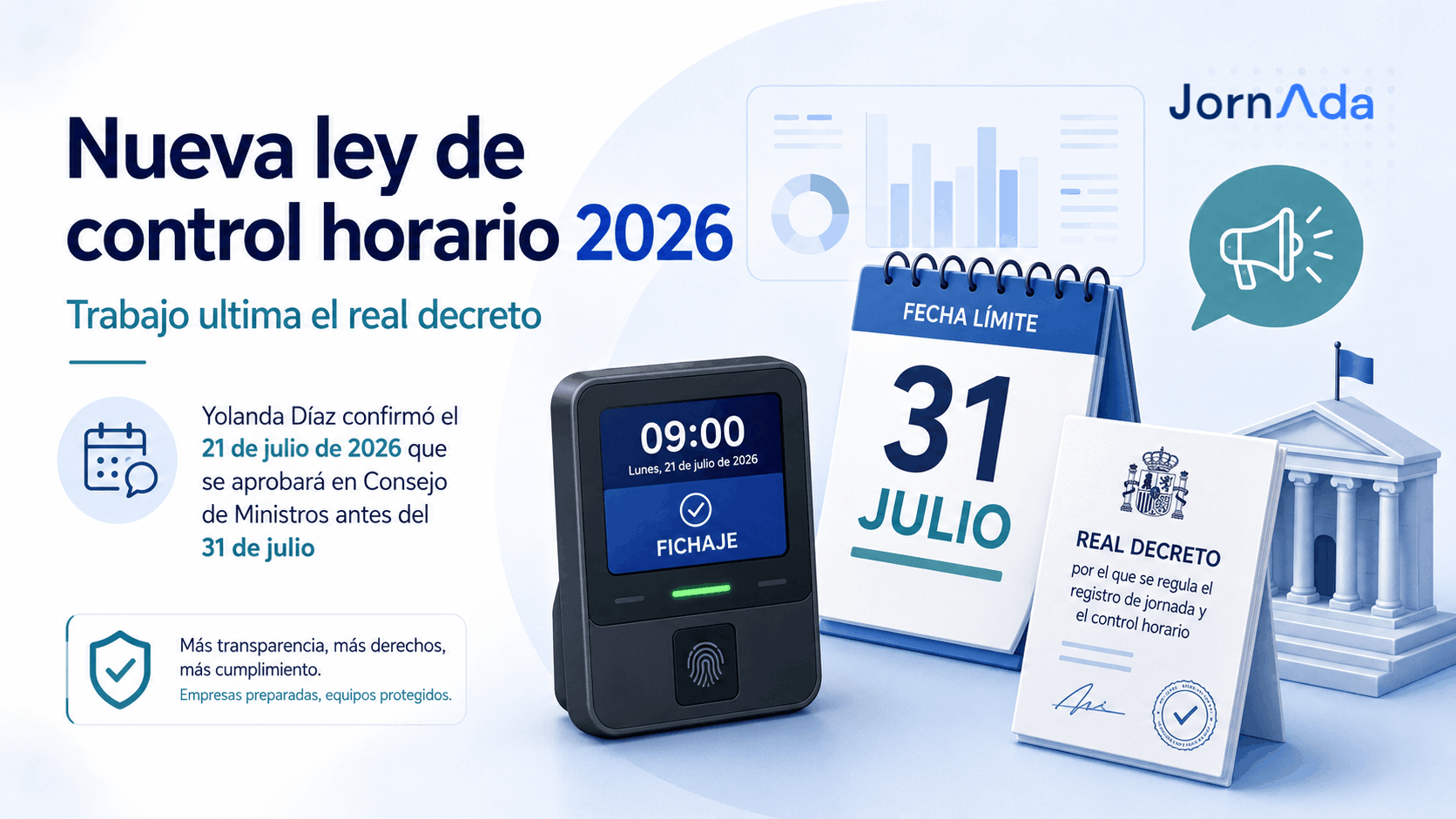
Audit and traceability. All system actions (configuration changes, dashboard accesses, permission modifications) are logged with timestamp and author, as required by GDPR and Spain's new 2026 digital clock-in regulation.
Frequently asked questions about emotional clock-in
Is it mandatory for the employee to respond?
No. It's 100% voluntary. The worker can clock out without rating their mood. This voluntariness is what guarantees honest responses.
Who sees the responses?
Administrators designated by the company see aggregate data (averages, trends, department comparisons). They don't see individual responses if the employee chose anonymous. Your company configures permissions by hierarchy: who gets access to the global dashboard, who sees data by site or department.
Can you tell who answered what?
No, if the employee chose anonymous. JornAda technically separates the worker's identity from the anonymous emotional response, so it can't be cross-referenced afterwards. In small teams (fewer than 5 people), responses are aggregated into a larger group to prevent identification by elimination.
Is using emotional clock-in legal?
Yes, as long as it's voluntary, anonymous and the data is processed in accordance with GDPR. JornAda complies with all these requirements and provides the documentation your Legal Department needs.
Does it work with remote and hybrid teams?
Yes. Just like the rest of JornAda's clock-in, it works from the mobile app or web browser, whether the employee is on-site, hybrid or remote.
How do I manage this in a company with thousands of employees?
JornAda allows assigning permissions by levels: the Head of HR sees the global aggregate, area managers see only their team, and specific dashboards can be configured by site, department or shift.
What do I do if I detect a sustained drop in a team?
JornAda doesn't make decisions for you, but gives you the data to make them. The typical procedure is to check with the team's direct manager, open a qualitative conversation with a representative group, and act on the causes (workload, leadership, organisational changes).
Does emotional clock-in add time to clocking out?
Between 2 and 5 seconds per employee. Five emojis and an optional comment. For the tool to be used, it must be fast.
Does it integrate with SAP, Workday or BambooHR?
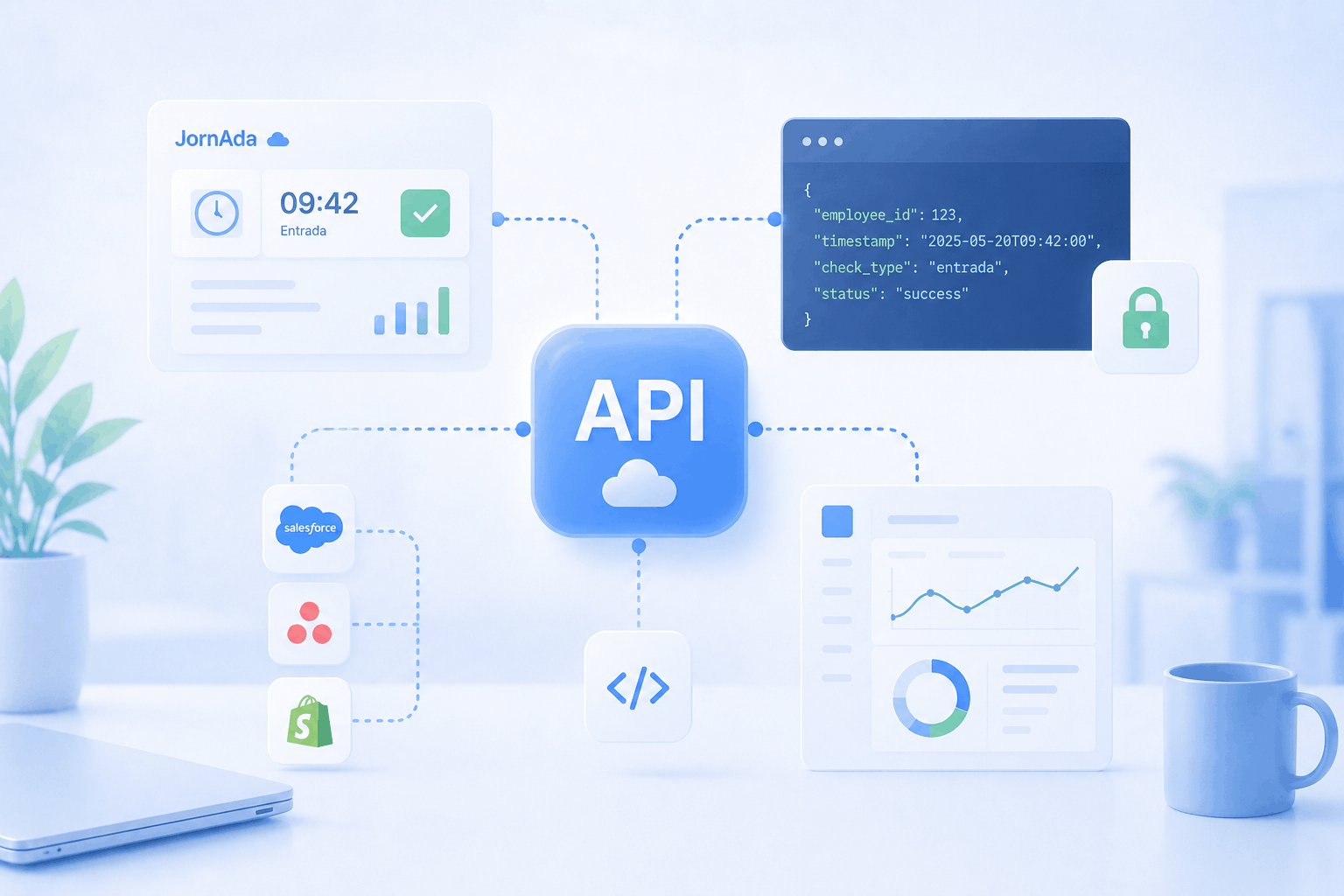
JornAda allows data export in standard formats (CSV, Excel, PDF) and offers an API for specific integrations. For large companies, we advise on integration with the main HRIS systems on the market.
How long until a reliable pattern appears?
The first useful patterns appear between weeks two and four of usage. For analysis with statistical depth (seasonality, year-over-year comparison), at least one quarter of data is recommended.
How much does the emotional clock-in module cost?
It's included at no extra cost in any JornAda plan. For companies with more than 50 employees we offer custom proposals with volume discounts.
How do I communicate this to my team so they actually use it?
Internal communication is one of the key success factors. We provide communication templates, explainer videos and onboarding materials specifically designed for large companies, plus dedicated support throughout the rollout.
More questions? Check our complete FAQ section or contact our sales team.
How to get started today
The big companies that will retain talent over the next 5 years won't be the ones with the prettiest employee portal, the most automated payroll or the most expensive wellbeing app. They'll be the ones that know, day by day, how their team feels and act before problems escalate.
Emotional clock-in doesn't replace mental health platforms, company culture or leadership. It complements them with something that didn't exist until today: a daily, reliable and zero-marginal-cost metric of your organisation's real emotional state.
JornAda is the only platform that connects the legal compliance of time tracking with continuous emotional wellbeing measurement. That's why it's the option big European companies are choosing when they want to stay one step ahead.
No new installation. No complex enterprise contracts. No additional cost on top of your time tracking plan. Direct support throughout the entire rollout.
You have three quick ways to start. If you want to see the module in action with real data, book a free 20-minute demo and we'll show it live. If you'd rather explore on your own, start your 15-day free trial with no credit card and no commitment. And if your company has more than 50 employees and you want a custom proposal, talk to our sales team: reach us at +34 971 14 38 36 or on WhatsApp.
Want more context before deciding? Visit the official team wellbeing page, check our plans and pricing or browse other articles on our blog about time tracking, digital clock-in and Human Resources management.
Last updated: April 2026. Article regularly updated with the latest trends in workplace wellbeing, product news and real implementation cases in large companies.