
Start your free trial of JornAda - 15 days free, no credit card required.
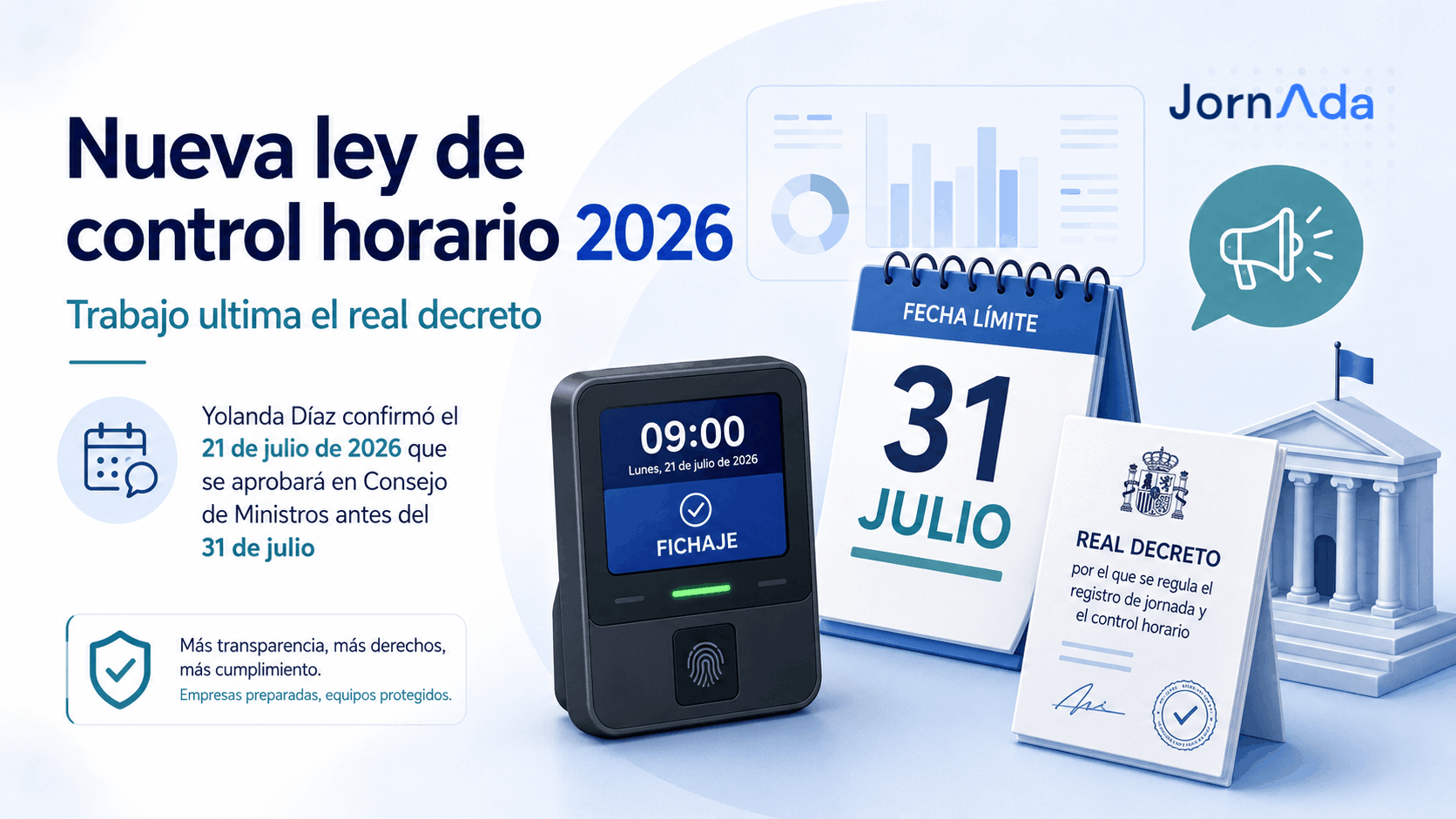
Try for freeMandatory digital time tracking in Spain is about to become reality. The Ministry of Labour is finalising the royal decree that fully overhauls working-time records, and on 21 July 2026 Vice-President Yolanda Díaz confirmed it will be approved by the Council of Ministers before 31 July. As of the publication of this article (23 July 2026) it has not yet appeared in the BOE (Official State Gazette), but it is imminent.
What changes, in one sentence: paper and spreadsheet records are over. Every company will have to clock in with a fully digital, automatic and interoperable system that the Labour Inspectorate can access remotely, with overtime recorded automatically and impossible to alter. Non-compliance will be punished with fines of up to €10,000 per worker. The government's rationale: the 2.5 million hours of unpaid overtime worked in Spain every year.
If you reached this page searching for "Spain time tracking law 2026", "mandatory digital clock-in Spain", "when does digital time tracking take effect", "fines for not tracking working hours" or "how to comply with the new working-time register", this is the most complete and up-to-date guide you will find. We are the team behind JornAda, Spanish time-tracking and clock-in software used by more than 3,000 companies, and here is everything you need to be ready.
Table of contents
- What just happened: approval before 31 July
- What changes vs. the current system: 6 key points
- Rollout timeline by company size
- Fines: up to €10,000 per worker
- Biometrics and geolocation: what the new text allows
- Checklist: does your current system comply?
- How to comply with the new law using JornAda
- Frequently asked questions
- Conclusion
What just happened: approval before 31 July
The new working-time register is being enacted by royal decree, with no parliamentary debate. On 21 July 2026 Yolanda Díaz confirmed the text is "almost ready" and will be approved by the Council of Ministers before the month ends. Once published in the BOE, the rule takes effect within days (the standard period is 20 calendar days).
This is the same decree the Council of State blocked in March 2026 with a near-100-page opinion: it questioned the cost (around €867 million for 1.35 million companies), the lack of adaptation to sectors with irregular hours (hospitality, agriculture, retail) and data protection. We covered it in detail in our article on how the Council of State struck down the decree while Labour pressed ahead. The July news is that Labour has rewritten the text to make it appeal-proof: it consulted the Spanish Data Protection Agency (AEPD) and, crucially, added a staggered rollout timeline that did not exist before. Employer body CEOE has nonetheless warned it may challenge the decree in court, arguing a change of this scale requires an act of parliament, not a decree.
What changes vs. the current system: 6 key points
Recording working hours has been mandatory in Spain since Royal Decree-Law 8/2019, but paper and spreadsheets were accepted until now. The new decree tightens the "how". These are the six changes that affect your company most:
- Fully digital clock-in: paper and spreadsheets are no longer valid. Time must be recorded electronically.
- Remote inspectorate access: the system must be interoperable and let the Labour Inspectorate review records remotely, without an on-site visit.
- Real-time, tamper-proof records: each clock-in and clock-out is stored instantly and cannot be changed without a trace. Any edit must log who did it, when and why.
- Automatic overtime: overtime is documented automatically and the company cannot alter it. This is the core of the reform: tackling the 2.5 million hours of unpaid overtime a year.
- Unique worker identification: the system must uniquely identify each worker, who records their own start and end of day.
- Four-year retention: records must be kept for four years and be available to staff, their legal representatives and the inspectorate.
If your company works overtime, see how it is calculated and paid in our 2026 overtime calculation guide.
Rollout timeline by company size
This is the big shift in the July version. The draft the Council of State blocked gave just 20 calendar days from BOE publication to comply, with no transition. After the criticism, Labour accepted a staggered rollout based on company size, giving SMEs and micro-businesses more room.
Based on the drafts circulated so far, the adaptation periods being considered once the decree is published in the BOE are, approximately:
- Large companies (250+ employees): around 6 months.
- Medium-sized companies (50–249 employees): around 9 months.
- Small companies and micro-businesses (fewer than 50): around 12 months.
Important: the exact figures will not be confirmed until the final text is published in the BOE. We will update this article with the official deadlines as soon as they are published. What is certain is that the obligation applies to every company with salaried employees, regardless of size or sector.
Fines: up to €10,000 per worker
Failing to keep the working-time record, falsifying it or obstructing checks is a serious or very serious labour offence. The new framework raises fines significantly and, above all, keeps the principle that they are calculated per affected worker, not per company. Broadly:
- Minor offence: from around €1,000.
- Serious offence: from around €2,000 up to €7,500 per worker.
- Very serious offence: up to €10,000 per worker affected.
Being calculated per person is what drives the risk: a 20-employee company without a valid record can accumulate a fine of hundreds of thousands of euros. Across the 3,000+ companies using JornAda, the most common compliance failure we see is not bad faith but relying on a spreadsheet any inspector considers editable. That is exactly the scenario the new decree aims to eliminate.
Biometrics and geolocation: what the new text allows
A top question is whether fingerprint or facial recognition clock-in will still be allowed. The AEPD treats biometrics as specially protected data and advises against them when a less intrusive alternative exists. The new decree adopts that criterion: fingerprint and facial recognition are restricted and only admissible if there is no reasonable alternative, after a proportionality assessment.
Geolocation, by contrast, is allowed for mobile workers, provided GDPR is respected: it must be one-off (recording the clock-in location, not continuous tracking), disclosed and proportionate. For most companies, the safest and simplest route remains clocking in via app, web, PIN kiosk tablet or card reader.
Checklist: does your current system comply?
Check in a minute whether your clock-in method will survive the new decree. Your system should answer "yes" to all of this:
- Is it digital? Paper or spreadsheets will not comply. These methods are no longer valid.
- Is it tamper-proof and traceable? It must log every change with author, date and reason.
- Does it record overtime automatically? Without relying on someone entering it by hand.
- Does it allow inspectorate access? It must export records in a verifiable way.
- Does it uniquely identify each worker? And let the person do their own clock-in.
- Does it keep data for 4 years? And make it available to staff and representatives.
If you answered "no" to any of these, you have work to do before your adaptation period runs out.
How to comply with the new law using JornAda
JornAda is Spanish time-tracking and clock-in software, built in Mallorca and 100% aligned with Spanish labour law. It is designed for exactly the scenario the new decree sets out: digital, tamper-proof records, automatic overtime and inspectorate-ready exports. With JornAda your company complies with no building work or complex installation:
- Multi-device clock-in: iOS and Android app, web, kiosk-mode tablet with PIN and Wi-Fi RFID card reader, with no on-premise servers.
- Tamper-proof, auditable records: every entry is time-stamped and traced, with a full change history.
- Automatic overtime and balances: calculated from the configured schedule.
- Optional, GDPR-compliant geolocation for mobile teams.
- Shift planning, holidays, absences and AI document management (bulk payslip delivery and digital signature) in one platform.
- From €2 per user/month, with a free trial and no lock-in.
See how it compares with the rest of the market in our guide to the best time-tracking software in Spain, and if you run a restaurant or hotel, in our dedicated hospitality time-tracking guide.
Frequently asked questions
When does Spain's new time tracking law take effect?
The royal decree will be approved by the Council of Ministers before 31 July 2026 and takes effect within days of its BOE publication (the standard period is 20 calendar days). From then, each company gets its adaptation period based on size.
Is digital clock-in mandatory for the self-employed and SMEs?
The digital record obligation applies to every company with salaried employees, including SMEs and micro-businesses. A self-employed person with no staff is not required to record their own hours, but must do so if they employ others. SMEs will get a longer adaptation period.
Can I still track hours in a spreadsheet or on paper?
No. Once the new decree is in force, paper and spreadsheets are no longer valid working-time records. Clock-in must use a digital, tamper-proof system interoperable with the inspectorate.
What is the fine for not tracking working hours?
Fines are calculated per affected worker and can reach €10,000 per person for very serious offences. A company with several employees and no valid record can accumulate fines of tens or hundreds of thousands of euros.
Is fingerprint or facial recognition clock-in legal?
Biometrics are heavily restricted. The AEPD treats them as specially protected data and only allows them when no less intrusive alternative exists. For most companies, clocking in via app, PIN or card is safer.
Can a company geolocate employees when they clock in?
Yes, for mobile workers and under GDPR: geolocation must be one-off (the clock-in location), disclosed and proportionate. Continuous location tracking is not lawful.
How long must working-time records be kept?
Four years, and they must be available to staff, their legal representatives and the Labour Inspectorate.
Conclusion
Spain's 2026 time tracking law does not change the "what" (recording hours was already mandatory) but the "how": digital, automatic, tamper-proof and accessible to the inspectorate, with fines up to €10,000 per worker and a rollout timeline by company size. The good news is that complying is simple if you pick the right tool before your deadline runs out.
Start your free JornAda trial and get your working-time records ready for the new decree, or see our plans from €2 per user/month. We will update this article with the official deadlines and figures as soon as the royal decree is published in the BOE.
Try JornAda for free
Start complying with time tracking regulations today. 15-day free trial, no credit card needed.
Contact
Any questions?
Fill in the form and we will get back to you within 24 hours.
Contact Name
Company Name *
Email *
Type your message here...
By sending you accept the Terms and Conditions and the Privacity Policy
Related news

Introducing Emotional Clock-In: Employee Wellbeing 2026
Introducing Emotional Clock-In: the simplest way to measure your team's wellbeing every day. Anonymous, real-time and built for large companies.
Read more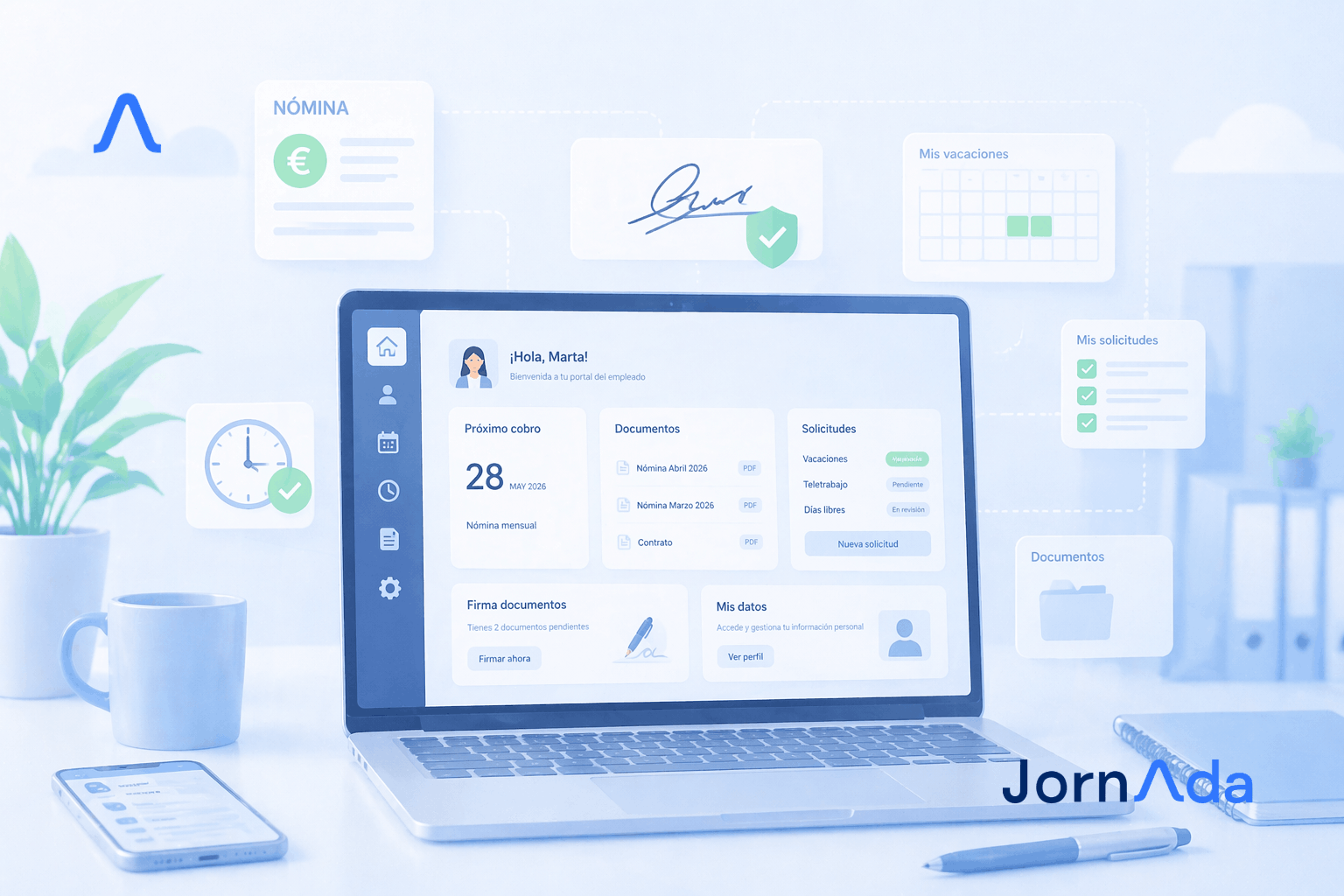
Employee Portal: What It Is, Features and Best Software in 2026
Time tracking, bulk payslips with AI, digital signatures and shared folders. Everything about employee portals and how to choose the best HR software in 2026.
Read more
The 12 Best Time-Tracking Software Solutions in Spain (2026): Full Comparison
We analyze the 12 most used time-tracking software solutions in Spain in 2026. Features, pricing, support, and which option is best for your company.
Read more